Wastewater Considerations in Wool Finishing: What Process Teams Should Flag Early
A finishing change is never only a finishing change. In a wool processing mill, even a small adjustment to scouring, anti-felting, surface smoothing, or handle improvement can alter what moves downstream into rinses, holding tanks, and treatment steps.
Enzymes are often evaluated for their textile benefits first: cleaner fiber surface, improved handle, more controlled shrink performance, lower harshness, and fewer corrective passes. Those benefits matter. But process teams should also look early at how the change may influence effluent character, not after the first production lot has already moved through the mill.
Lanefold works as an enzyme supplier for wool processing mills with a production-minded view: the right product must fit the fabric, the bath, the finishing objective, and the mill’s wastewater reality.
Why wastewater belongs in the first process conversation
Wool finishing already carries natural variability. Fiber origin, grease residue, dyestuff system, auxiliaries, mechanical action, liquor exchange, and rinse behavior all affect what exits the machine.
When an enzyme step is introduced or adjusted, the wastewater question is not simply whether the enzyme itself is present. The more useful question is:
What changes in the total bath and rinse stream because the process now behaves differently?
That may include:
- Changes in removed surface material from the wool fiber
- Differences in surfactant or auxiliary carryover
- Reduced need for aggressive finishing corrections
- Modified rinse clarity or suspended solids behavior
- Different loading across equalization or treatment steps
- More consistent lots, which can reduce erratic discharge patterns
The aim is not to make regulatory assumptions from the finishing floor. The aim is to give the environmental, utility, and process teams enough early visibility to monitor the right points.
Start with the finishing objective
Wastewater review should begin with the reason for the enzyme trial.
If the target is shrink control
Enzyme-supported shrink control may change how much surface modification occurs before rinsing. The team should watch how the treated wool releases fines, residual chemistry, and loose fiber fragments during post-treatment washing.
Useful early questions include:
- Does rinse turbidity change compared with the current route?
- Is there less reprocessing due to missed shrink targets?
- Does fabric strength remain within the mill’s acceptance window?
- Are downstream baths receiving a steadier or more variable load?
If the target is softer handle
A handle-focused enzyme step may reduce the need for harsher mechanical or chemical finishing corrections. That can be valuable, but it still deserves wastewater review.
Flag the relationship between:
- Softness improvement and rinse behavior
- Surface cleanliness and extracted material
- Fabric fullness and mechanical action
- Shade preservation and rework reduction
If improved handle reduces repeated finishing, the total wastewater impact may look different from the impact of a single bath.
If the target is surface cleanliness
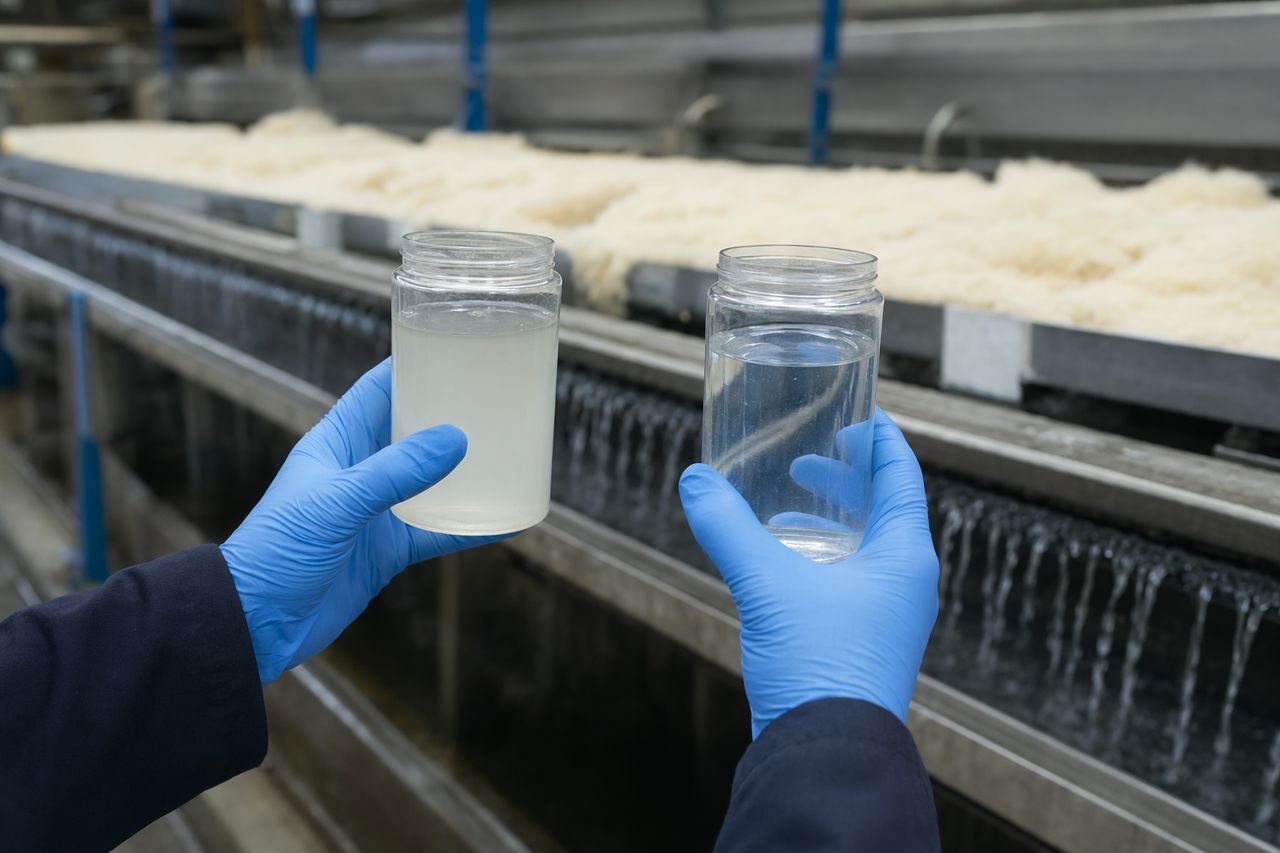
Enzymes used to refine the wool surface can shift what is removed from the fiber. Process teams should compare bath appearance, filter loading, and rinse character against the existing process.
The key is to observe both the main treatment bath and the following rinses. A clean-looking treatment bath does not always mean the downstream load is unchanged.
Map the route before the trial
Before running a production-scale change, create a simple route map. It does not need to be complex. It should show where the wool travels, where fresh water enters, where drainage occurs, and where streams combine.
Include:
-
Pre-wet or scouring stage
Note residual grease, detergents, and incoming variability. -
Enzyme application bath
Record normal bath conditions, contact time, mechanical action, and fabric load profile. -
Stop or transition step
Identify how the enzyme stage is brought under control before the next process. -
Rinsing sequence
Separate early rinse behavior from final rinse clarity where possible. -
Dyeing or after-treatment interaction
Watch shade stability, redeposition, and handfeel changes. -
Effluent collection point
Confirm whether the stream is isolated, blended, equalized, or sent directly forward.
This route map gives both the finishing manager and wastewater team a shared picture. It also helps distinguish an actual enzyme effect from a normal lot-to-lot wool variation.
What to monitor during an enzyme change
Lanefold does not treat wastewater monitoring as a separate department issue. In mills, the practical signals often appear first at the machine: bath feel, foam behavior, rinse clarity, filter loading, shade repeatability, and rework frequency.
Consider tracking:
- Bath appearance: color, haze, scum, surface film, and foam tendency
- Rinse behavior: how quickly the water clears and whether fine solids persist
- Fabric result: handle, shrink response, tensile confidence, pilling tendency, and surface smoothness
- Shade preservation: especially on dyed wool or shade-sensitive routes
- Treatment load signals: solids capture, settling behavior, and day-to-day consistency
- Operational outcomes: fewer corrective runs, fewer rejected lots, and lower rewash demand
The most useful comparison is not a perfect laboratory snapshot. It is a side-by-side production view under similar fiber, shade, machine, and bath conditions.
Avoid isolating one number too early
When a new finishing chemistry is trialed, teams may be tempted to look for a single wastewater number that tells the whole story. Wool finishing rarely works that way.
A more reliable approach is to compare the complete route:
- Current process versus enzyme-supported process
- First bath plus rinses, not first bath alone
- Accepted lots versus corrected lots
- Typical day versus trial day
- Machine behavior plus treatment response
This prevents the team from overreacting to one isolated measurement while missing a larger production benefit, such as fewer repeats or more stable discharge patterns.
Coordinate finishing, dyehouse, and wastewater teams
A process change is smoother when the affected teams are involved before the first trial lot.
The finishing manager can define fabric objectives and acceptance criteria. The dyehouse can flag shade risks, pH sensitivity, and downstream compatibility. The wastewater team can identify where to sample, what to observe, and when a change should be escalated.
Early coordination helps answer practical questions:
- Should the trial stream be observed separately before blending?
- Which rinse should receive closest attention?
- Are holding tanks large enough to smooth short-term variation?
- Does the new route reduce rework water enough to matter operationally?
- Are any auxiliaries being reduced or replaced at the same time?
This is where enzyme selection becomes more than product matching. It becomes process fitting.
Rework reduction can change the wastewater picture
One of the most overlooked wastewater considerations is avoided rework.
If an enzyme step improves reproducibility, the mill may reduce:
- Second-pass softening
- Corrective washing
- Additional anti-felting adjustments
- Shade correction linked to harsh processing
- Rehandling after failed shrink or handle targets
Those avoided steps matter. They consume water, heat, chemicals, labor, and machine capacity. They also contribute to effluent volume and variability.
For this reason, wastewater review should include both the immediate enzyme bath and the operational effect across accepted production lots.
Keep fiber strength and shade in the same review
Wastewater goals should never be separated from fabric quality. A lower-load process is not useful if it creates tender fiber, dull shade, unstable handle, or unpredictable shrink response.
For wool mills, the best enzyme route is balanced:
- Controlled surface action
- Preserved fiber strength
- Clean rinsing behavior
- Stable shade appearance
- Repeatable handle
- Reduced corrective work
That balance depends on product choice, bath conditions, machine action, fabric construction, and the finishing target.
Questions to ask your enzyme supplier before a trial
Before approving a new enzyme route, ask questions that connect product performance to mill reality:
- Which finishing objective is this enzyme best suited for in wool?
- How should we think about rinse behavior and removed surface material?
- What process conditions are most important for reproducible lots?
- How should we coordinate the trial with wastewater observation?
- What fabric risks should we watch first: strength, shade, handle, or shrink response?
- Can the recommendation fit our existing machine route with minimal disruption?
- How should we compare rework reduction against any bath-level changes?
A credible supplier should be comfortable discussing both textile performance and process implications without overstating wastewater outcomes.
A practical trial structure
For mills preparing an enzyme evaluation, Lanefold recommends a simple trial structure:
-
Define the fabric target
Shrink control, handle, surface cleanliness, or rework reduction. -
Select a comparable reference lot
Keep wool type, construction, shade, and machine route as close as possible. -
Agree on bath conditions before the run
Avoid changing multiple variables at once. -
Observe first bath and rinses
Record visual and operational behavior, not only final fabric feel. -
Check quality before scaling
Confirm handle, shrink behavior, shade, and strength confidence. -
Review treatment signals with the wastewater team
Look for load changes, consistency, and any handling concerns. -
Account for avoided rework
Compare the full production route, not only the enzyme step.
Process confidence before scale-up
Wastewater considerations should not block sensible finishing innovation. They should make it easier to scale with confidence.
When the process team understands how an enzyme route affects bath behavior, rinse release, fabric quality, and rework frequency, the decision becomes clearer. The mill can move from a promising trial to a reproducible production route with fewer surprises.
Lanefold supports wool processing mills with enzyme recommendations built around real finishing constraints: handle, shrink control, surface cleanliness, shade preservation, fiber strength, bath compatibility, and lot-to-lot repeatability.
Request a quote
If you are reviewing an enzyme change in wool finishing, share your fabric type, finishing target, current route, and any wastewater observation points you need to protect.
Request a quote through the on-site form and Lanefold will help match an enzyme approach to your mill process, production goals, and scale-up requirements.